

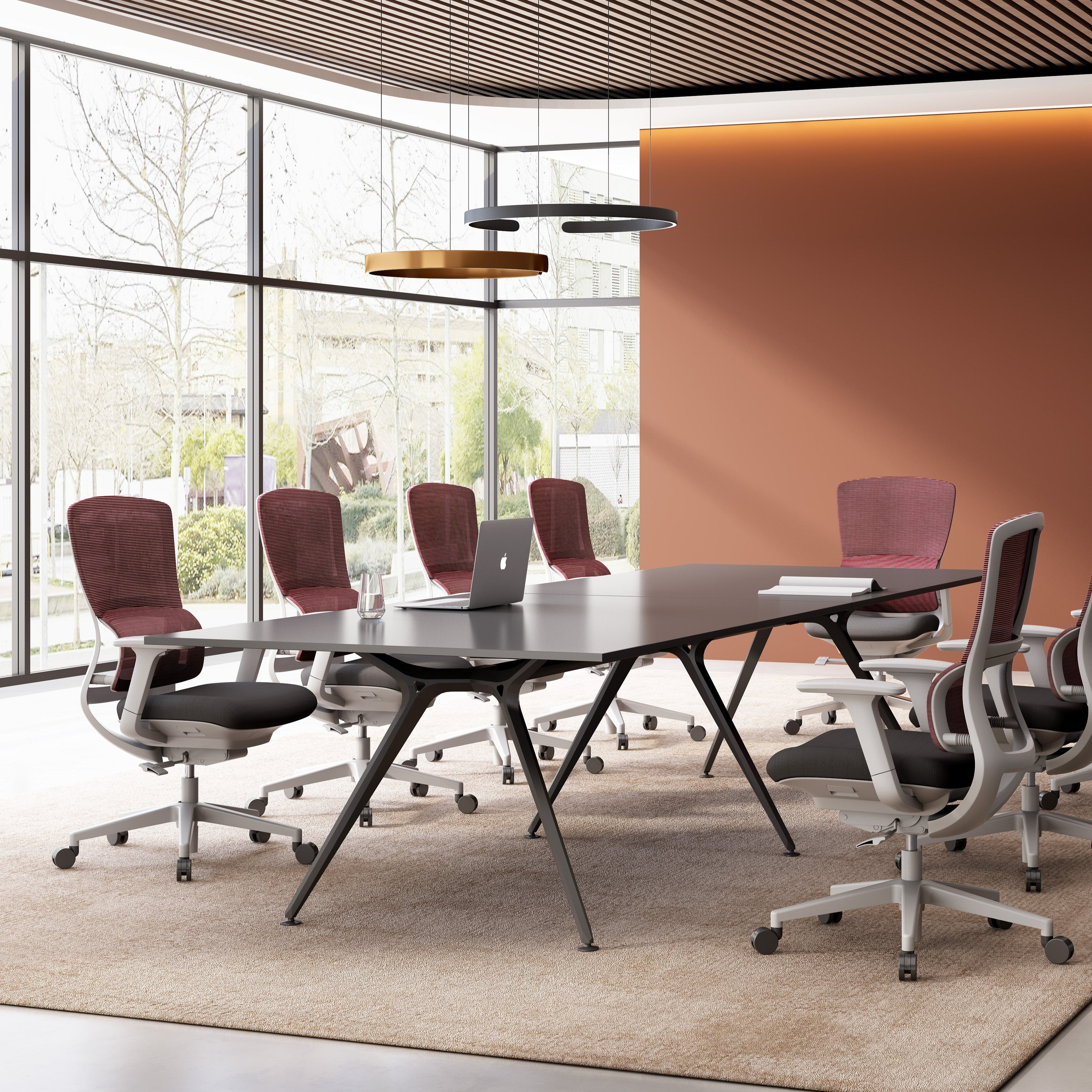

The office chair order that causes trouble is almost never the one that failed inspection on delivery. It is the one that arrived complete, matched the quote, and started failing in month nine.
A gas lift that will not hold its height. An armrest that cracks. A recline mechanism with a wobble nobody can fix, because the part is not stocked in Canada. By then the saving is gone, and the replacement units and hours spent chasing a supplier cost more than the original price gap justified.
The fix is not a bigger budget. It is a written specification. A chair specification that names a performance standard, a set of measured adjustment ranges, an occupant and duty rating, and a replacement parts term will outperform one that names a price, because those four lines decide whether the chair is still in service in year ten. Most quotes answer none of them.
Why does a written specification beat a price comparison?
A specification is a written list of measurable requirements a chair must meet before it qualifies for your order. It differs from a product description because every line can be verified against a document or a measurement. A price comparison ranks the quotes you received. A specification decides which quotes belong in the comparison at all.
- It makes competing quotes genuinely comparable, because every supplier answers the same questions in the same units
- It shifts the risk of premature failure onto the supplier, who has agreed in writing to a standard rather than to an adjective
- It gives finance a defensible reason to approve the higher of two quotes, which is usually the real obstacle
- It becomes the internal alignment document for a buying committee that routinely runs to six or more people across facilities, IT, finance and procurement
That last point is the one most buyers underestimate. Facilities cares about fit and floor protection, finance about total cost, procurement about vendor risk.
A specification is the only artifact all of them can review at once, so writing it does double work: it disciplines the supplier and settles the internal argument before the order goes out.
What performance evidence should you ask a supplier to produce?
Performance evidence is documentation showing how a chair behaved under measured testing, rather than a description of how it was built. Any supplier can call a chair commercial grade. Far fewer can produce a report with numbers in it, and the gap between those two groups is the most useful filter in the whole process.
So ask for the written test report, and check that it names:
- The exact model and configuration tested, not a product family
- The measured results as figures, rather than a pass or fail summary
- The date of testing, ideally within the last three years
- The laboratory or facility that carried out the testing
A supplier who produces that document in a day is a different proposition from one who needs a week to ask someone else for it. The response time itself tells you who controls the product, and who is simply passing your question along a supply chain.
Why is the word ergonomic not a specification?
Because it describes a fit between a chair and a person, not a property of the chair.
A chair sold as ergonomic is designed to suit a range of people, with no guarantee that it suits any particular one. A chair becomes ergonomic only when it fits a specific worker's body dimensions, their workstation and the tasks they perform there.
A fully adjustable chair is expected to accommodate roughly ninety percent of the population, with the shortest and tallest five percent needing something custom. For a team order that reframes the entire question. You are not buying an ergonomic chair. You are buying an adjustment range wide enough to cover your actual people, and the specification is where you write down how wide that has to be.
Which adjustment ranges belong in the specification?
An adjustment range is the measured distance a component can travel, written as a number. Fully adjustable is not a specification. A seat height range in millimetres is. For a team order this distinction decides how many complaints you receive in month two.
- Seat height: the commercial range runs to roughly 430 to 530 mm, which covers most adult users sharing a floor
- Seat depth: the seat pan should travel around 50 to 80 mm, so users with different leg lengths can set thigh support without giving up back contact
- Lumbar support: specify vertical adjustment and depth adjustment as two separate lines, because a pad that slides up and down but not in and out will not fit every back
- Armrests: state which axes must adjust, since height only, height and width, and full four way movement are three different products at three different prices
- Base and controls: specify a stable five point base and controls that can be operated from a seated position, both of which CCOHS lists as baseline requirements.

Specify the range rather than the target, because a fleet is judged at its extremes. This is the practical consequence of the CCOHS point above. A chair that fits the middle of your team beautifully and fits nobody in the shortest or tallest five percent generates the same complaint volume as a cheap chair, and it generates it from the people most likely to escalate.
How do you specify durability instead of describing it?
Durability in a specification is expressed as cycle counts and load ratings, not adjectives. Any supplier who genuinely tests their seating already holds these numbers, so the specification's job is simply to require that they be disclosed as figures rather than summarised into a claim.
- Ask for the cycle count the backrest and armrests were tested to, as a figure
- Ask for the castor rotation cycle count as a figure, since castors are where shared floor chairs usually fail first
- Ask what load was applied to the seat and backrest during testing, and for how long it was sustained
- State the occupant weight range the fleet must serve, and ask whether the supplier offers a higher rated option for users who fall outside it
- For boardrooms and training rooms, specify a multi user duty rating rather than a single user eight hour rating, and state the stack height your storage space allows if stacking office chairs are required
The occupant range is where single specification orders quietly fail. If some of your users fall outside the range a chair is rated for, specifying one model for the whole floor guarantees a fit problem, a warranty problem, or both. Write one specification with two qualifying chair options instead, ordered in the mix your headcount actually requires.
What should the specification say about replacement parts and lead time?
A replacement parts clause states how long the supplier will supply components, which components are covered, and where those parts ship from. It is the single line that separates a repairable chair from a disposable one, and it is the line most often left out entirely.
Parts availability is really a question about tooling. A manufacturer that owns the dies, moulds and fixtures for its own components can produce a replacement part years after a model changes, because the means of production sits in its own building.
A supplier reselling finished chairs can only offer what its source still stocks. Same chair on the quote, completely different answer in year four.
- Ask who owns the tooling for the chair's components, and get the answer in writing
- Ask where replacement parts ship from, because a warranty honoured from another continent is measured in months rather than days
- Specify a lead time ceiling for the initial order and for parts, since project driven buyers commonly work to a ten week maximum
- Specify the service life you are planning against, since institutional buyers typically expect ten to fifteen years and prefer warranty terms of ten years or more
This is where CEHA sits differently in a comparison. We have manufactured sheet metal furniture for more than 53 years, we own our own designs and tooling, and we ship from our facility in the Greater Toronto Area. When a component is needed in year six, it is produced here rather than sourced from whoever still stocks it.
Specifying seating for a team?
Browse commercial office chairs shipped from our GTA facility, or contact us with your requirement list and we will answer it line by line.
What should you require from the supplier, not just from the chair?
Supplier requirements are the clauses that determine whether the order arrives correctly and stays supported afterwards. They sit alongside the product requirements and carry equal weight in any serious procurement decision.
- Request an evaluation unit before committing the full order, and put it in front of the people who will actually sit in it
- Ask where the chairs are manufactured and where they ship from, since both affect lead time and both affect what happens when something needs replacing
- Ask whether the supplier manufactures or resells, because that answer tells you who you will actually be negotiating with about a defect
Two objections come up reliably here. The first is that this is too much process for a twelve chair order. It scales down cleanly: four lines carry most of the risk, being the test report, the seat height and depth ranges, the occupant and duty rating, and the parts term. That is a short email, not a tender document.
The second is that a tighter specification raises the price. It narrows the field to suppliers who can answer, which usually removes both the cheapest quote and the most expensive one. What it removes from the cheap end is the quote that was cheap because something had been left out, and finding out which thing after delivery is the expensive version of this conversation.

One step no document replaces: sit in the chair. Canadian buyers consistently rate the ability to test furniture before ordering as a top trust signal, and for a multi unit order it is the cheapest risk reduction available. Our Markham showroom exists for this. For smaller spaces, our guide to home office organization covers the layout side of the same decision.
A specification checklist to send with your next request for quote
Copy these ten lines into your next enquiry. A supplier who answers all ten without hesitation is worth shortlisting.
- What performance testing has this chair undergone, and can you supply the written report?
- Does that report name the exact model, configuration, measured results, test date and testing facility?
- What is the seat height adjustment range in millimetres?
- What is the seat depth travel in millimetres?
- Is lumbar support adjustable vertically, by depth, or both?
- Which armrest axes adjust?
- What occupant weight range is this chair rated for, and do you offer a higher rated option?
- What cycle counts were the backrest, armrests and castors tested to?
- Who owns the tooling for the components, how long will parts be available, and where do they ship from?
- What is your committed lead time for the initial order and for replacement parts?
Order Seating You Can Still Repair in Year Ten
A specification takes an hour to write and decides a decade of service life. Write the four lines that matter, send the ten questions, and let the answers narrow the field.
Specify the room as one document rather than three purchase decisions, covering seating alongside your office tables and desks and any metal pedestals.
Browse commercial office chairs built and shipped from our Greater Toronto Area facility, browse the full range of office furniture solutions, or book a showroom visit in Markham to sit in the chair before you order twenty of them. Send us your specification and we will answer it line by line.
Built with 53 years of metal manufacturing expertise. Built for Life in Canada.


