

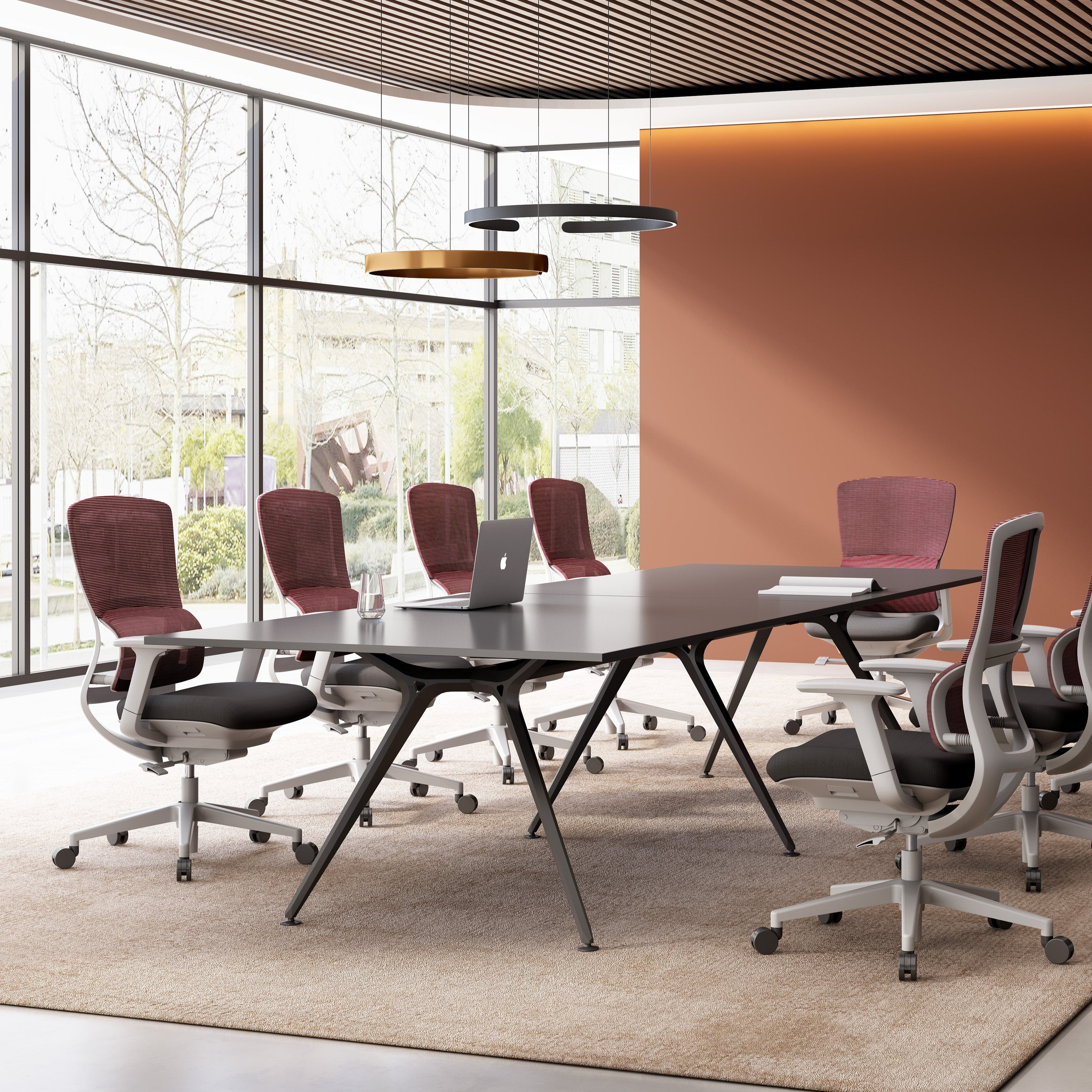

Most Canadian businesses should budget CAD $120 to $250 per seat for basic task or guest chairs, CAD $250 to $550 per seat for ergonomic seating used more than four hours a day, and CAD $550 to $1,200 or more per seat for executive or boardroom chairs. The right number depends less on the chair's sticker price and more on how many hours a seat is used, how long the chair needs to last, and what a warranty claim actually costs to resolve.
What Actually Drives Office Chair Cost in Canada?
Office chair pricing in Canada is shaped by four factors: the mechanism quality (tilt, lumbar, and height adjustment components), the materials used in the frame and upholstery, the warranty term and what it covers, and the manufacturer's distance from the buyer. A chair with a five-year mechanism warranty and a Canadian-based parts supplier carries a different total cost than a visually similar chair sourced through several layers of importers, even if the sticker price is identical.

Businesses that buy on sticker price alone tend to relearn this the hard way. A chair that fails a mechanism after 18 months, with a six-week replacement-parts wait from an overseas supplier, costs more in downtime and re-purchasing than a chair that cost 20 percent more up front.
Per-Seat Budget Tiers for Canadian Offices
Not every seat in a business needs the same chair. Budgeting works better when it is split by how the seat is actually used, not by a single company-wide number.
Task and guest seating (occasional use, under two hours a day)
Budget CAD $120 to $250 per seat. This covers reception areas, meeting rooms, and stations used in shifts rather than by one person all day. Adjustment needs are minimal, so the budget goes toward frame durability and stacking or ganging hardware rather than ergonomic mechanisms.
Ergonomic and task-pro seating (primary workstations, four or more hours a day)
Budget CAD $250 to $550 per seat. This is where most of a company's chair budget should concentrate, since it covers the desks where employees spend the majority of their working day. Look for adjustable lumbar support, seat depth adjustment, and a five-year minimum mechanism warranty at this tier.
Executive and boardroom seating
Budget CAD $550 to $1,200 or more per seat. This tier is driven as much by presentation and client-facing image as by ergonomics, and it typically covers a smaller seat count than the other two tiers combined.
|
Seating Tier |
Typical Use Case |
Budget Per Seat (CAD) |
Priority Feature |
|
Task / Guest |
Reception, meeting rooms, shift stations |
$120 to $250 |
Frame durability, stacking hardware |
|
Ergonomic / Task-Pro |
Primary workstations, 4+ hrs/day |
$250 to $550 |
Lumbar adjustment, mechanism warranty |
|
Executive / Boardroom |
Leadership offices, client-facing rooms |
$550 to $1,200+ |
Presentation, upholstery, warranty term |
A 20-person office is rarely 20 identical chairs. A more realistic split is 60 percent ergonomic task-pro seating, 30 percent task or guest seating, and 10 percent executive seating, which keeps the largest share of the budget where employees spend the most hours.
Why Per-Unit Price Is Not the Same as Total Cost?
The purchase price is the number in the quote. The total cost of ownership is what the chair actually costs across its working life, including warranty claims, replacement parts, and the labour hours spent managing a failed order.
A procurement officer comparing two chairs at $280 and $340 is not comparing two prices. They are comparing a five-year mechanism warranty against a two-year one, and a supplier who can ship a replacement part from a Canadian facility against one who cannot confirm a restock date. Over a five-year seat life, the cheaper chair with the shorter warranty is frequently the more expensive decision once a single mechanism failure is factored in.
This is also why the majority of Canadian institutional RFPs weight technical merit and lifecycle criteria above unit price. Buyers who have already been through a failed bulk order tend to ask about warranty terms and parts availability before they ask about price.
Ready to put real numbers against your seat count? Browse office chairs built with a five-year mechanism warranty and Canadian-based support, so a budget built today still holds in year four.
How Many Seats Actually Need Premium Ergonomic Chairs?
Not every role needs the same tier, and over-buying ergonomic chairs for a rarely used meeting room wastes budget that would be better spent reinforcing the workstations used all day.
A simple way to segment a seat count:
-
Full-time desk-based staff (4+ hours seated daily) need ergonomic or task-pro seating.
-
Hybrid staff who are in-office two or three days a week can often use task-pro seating shared across hot desks.
-
Meeting rooms, training rooms, and reception areas can run on task or guest seating.
-
Leadership and client-facing offices justify the executive tier, but usually represent under 15 percent of total seat count.
Segmenting this way before requesting quotes prevents the common overspend pattern: buying one chair tier for the entire office because it is simpler to order, then discovering the meeting room chairs cost as much as the workstation chairs that actually needed the budget.
Budgeting for Multi-Stakeholder Procurement Approval
Office seating purchases in Canadian businesses rarely move through a single decision-maker. A typical approval path involves a facilities or office manager identifying the need, a finance approver reviewing total cost against budget, and in larger organizations, a procurement purchaser managing the vendor relationship and delivery timeline.
Each stakeholder needs a different piece of the same budget conversation. Finance approvers want the total cost of ownership breakdown, not just the per-seat price. Procurement wants confirmed lead times and a single point of contact for warranty claims, since chasing a claim through multiple resellers is a recurring frustration in Canadian office furniture procurement. Facilities managers want to know the chair will still be in stock and serviceable in three years, not just available today.

Bringing a tiered budget table, like the one above, into that approval conversation does two things: it gives finance a number they can defend, and it shows procurement that the decision was based on total cost, not just the lowest quote.
Common Questions on Office Chair Budgets
Is it worth paying more for a mechanism warranty?
Yes, for any chair used more than four hours a day. Mechanism failures are the most common warranty claim on office seating, and a five-year mechanism warranty typically costs less over the chair's life than a two-year warranty plus a mid-cycle replacement.
Should every employee get the same chair?
No. Budget by usage tier instead. Full-time desk staff justify ergonomic seating, while shift stations, meeting rooms, and reception areas can run on a lower tier without affecting comfort where it matters.
How much should a small business budget for a first office chair order?
For a 10 to 20 seat office, a blended budget of roughly $300 to $350 per seat, weighted toward ergonomic task-pro chairs, covers most workstations without overspending on rarely used seats.
The right office chair budget is not one number. It is a tiered plan built around how many hours each seat is actually used, backed by a warranty term that matches that use. A business that budgets this way spends less over five years than one that buys the cheapest chair for every desk and replaces a third of them within 24 months.
Every CEHA office chair is backed by manufacturer-direct pricing and Canadian-based warranty support, built on 53 years of metal manufacturing expertise, so the number in your budget this year still holds up in year five. Browse the full office seating collection or visit our Markham showroom to test the ergonomic tiers before you commit a budget.
Built with 53 years of metal manufacturing expertise. Built for Life in Canada.


