

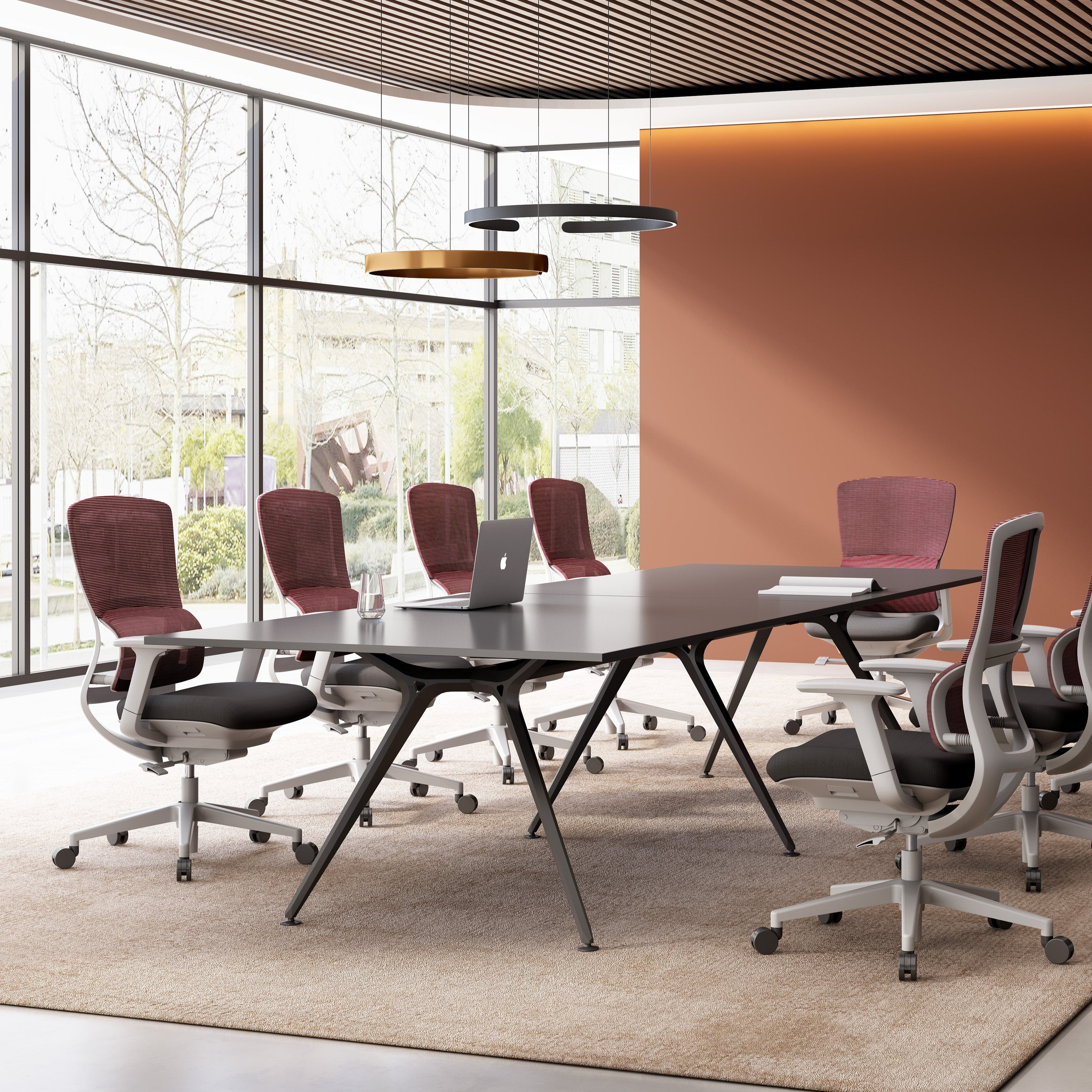

An office table does more than provide a surface to work on. It determines how efficiently you work, how comfortable you feel over a full day, and how well the space around you functions when multiple people need to use it.
Choosing a table that does not match the workspace can create daily inefficiencies. The wrong size limits your ability to work effectively.
The wrong configuration makes meetings harder to run. Some materials may not perform consistently over time in environments that require durability.
This guide covers everything you need to know before choosing an office table or workstation desk, from table types and dimensions to surface materials, space planning, and how to match the right configuration to your specific environment.
Explore the full range of office tables at CEHA Canada to find the right workstation setup for your home or workplace.
Why the Right Office Table Matters More Than Most People Realise
Most office furniture decisions focus on chairs and storage. The table itself often gets chosen last, based on what fits the space rather than what supports the work.
This is a mistake. The table plays a central role in every workstation. The chair, the storage, and the lighting are all positioned in relation to it.
A well-chosen office table:
-
Provides the right surface area for the tasks being performed without forcing the user to clear space before starting work
-
Supports a comfortable, ergonomically sound working posture across a full workday
-
Functions reliably under daily use without surface wear, wobble, or structural degradation
-
Adapts to different configurations when the workspace needs to serve multiple purposes
-
Contributes to a professional appearance that reflects well on the individual and the organisation
In Canadian homes and workplaces where hybrid work has made the workspace serve more roles than ever, the table you choose needs to perform across all of them.
Types of Office Tables and Workstation Desks
Not all office tables serve the same function. The right type depends on how the space is used, how many people use it, and whether the layout needs to change.
Fixed Workstation Desks
A fixed workstation desk is designed for a single user in a dedicated workspace. It stays in one position and is sized to accommodate everything the user needs within immediate reach.
Fixed desks are best suited for:
-
Dedicated home offices where the desk serves one person and one primary purpose
-
Commercial offices with assigned workstations where each employee has a defined workspace
-
Environments where stability and a permanent, integrated look are priorities
-
Users who require a consistent layout and benefit from a workspace that stays set up and ready
Folding and Multipurpose Tables
Folding and multipurpose tables are designed for flexibility.
They can be set up when needed and stored flat when not in use, which makes them one of the most space-efficient solutions available for rooms that serve more than one purpose.
The multipurpose folding table KMH from CEHA Canada is built for exactly this kind of multi-use environment.
It is ideal for:
-
Home offices that double as guest rooms, dining areas, or hobby spaces
-
Training rooms, meeting rooms, and event spaces that need to be reconfigured regularly
-
Offices with limited permanent floor space that need to maximise usable area for different activities throughout the day
-
Temporary workstations for visiting staff, contractors, or seasonal employees

Flip Top Tables
Flip top tables are designed specifically for meeting rooms, training environments, and collaborative workspaces.
The tabletop folds vertically, allowing multiple tables to be nested together and moved out of the way when the room needs to serve a different function.
CEHA Canada offers two flip top configurations:
-
The flip top table 55W x 24D for standard meeting and training room layouts

-
The flip top table 63W x 31.5D for larger collaborative setups that require more individual surface area per user

Flip top tables are the right choice for:
-
Meeting rooms that alternate between presentation layouts and collaborative arrangements
-
Training rooms where the number of attendees changes regularly
-
Offices that host events, workshops, or team sessions requiring flexible seating configurations
-
Organisations that need to maximise floor space efficiency without sacrificing meeting capacity
Key Factors to Consider When Choosing an Office Table
Choosing the right office table requires matching several factors to the actual demands of the space. A table that looks right online may not perform correctly in the environment it ends up in.
Surface Area and Dimensions
The surface area of an office table determines whether the work being done on it can be laid out comfortably or whether the user is constantly clearing space to function.
As a practical guide:
-
A single-user workstation desk should provide enough surface for a monitor, keyboard, documents, and daily-use items without crowding
-
A meeting or training table should allow each participant enough surface for a laptop or notepad plus comfortable elbow room
-
A folding or flip top table should be sized to the largest configuration the room will regularly need, not the smallest
For precise guidance on measuring your space before ordering, our storage cabinet size measurement guide walks through the key measurement steps that apply equally to table selection.
Height and Ergonomics
Standard desk height in Canada is typically 73 to 76 centimetres.
This suits most users working from a standard office chair, but the right height depends on the individual user's dimensions and the chair being used alongside the table.
A table that is too high forces the shoulders upward. A table that is too low creates forward neck flexion and lower back strain.
Both issues accumulate over a full workday and become significant over weeks and months of consistent use.
Stability and Build Quality
A table that wobbles, creaks, or shifts under regular use creates frustration and reduces the professional quality of the workspace.
Stability comes from the quality of the frame construction, the leg design, and the connection between the frame and the tabletop.
For environments with high daily use, choose a table built to commercial specifications.
A table built to commercial specifications will consistently outperform a lighter residential option in high-use environments.
Mobility and Storage
Tables with castors or locking wheels allow the layout of a room to be changed quickly without requiring heavy lifting.
For meeting rooms, training environments, and multipurpose spaces, mobility is often a deciding factor.
Flip top and folding tables address this directly. When not in use, they can be stored vertically or stacked against a wall, freeing the floor for other purposes entirely.
Office Tables for Different Workspace Types
The right table configuration depends on the type of workspace it will live in.
Here is how each CEHA Canada table type performs across the most common environments.
Home Office
In a home office, the table needs to serve the primary user effectively while fitting within a room that may also function as a bedroom, study, or guest space.
A folding table is one of the most practical solutions for a home office that shares space with other uses. It provides a full working surface when needed and folds flat when the room is serving a different purpose.
For a broader approach to structuring a productive home workspace, our guide on how to organise a home office for productivity covers layout and storage strategies that complement a well-chosen table.
Meeting Rooms and Training Spaces
Meeting rooms and training spaces place the highest demands on office table flexibility.
The layout needs to change regularly, the tables need to accommodate different numbers of participants, and the room needs to reset quickly between sessions.
Flip top tables solve all three requirements. They nest together for storage, deploy quickly for use, and provide a professional, consistent surface for every session.
Open-Plan and Shared Offices
In open-plan offices and shared workspaces, tables need to balance individual working needs with the visual coherence of the broader environment.
Consistent sizing, finish, and leg design across multiple tables contributes to an organised, professional appearance that makes the workspace feel intentional rather than assembled from different sources.
Multi-Use Spaces
Spaces that serve multiple purposes throughout the day require tables that can be reconfigured without effort.
A room that functions as a training space in the morning and a collaborative workspace in the afternoon needs tables that move, fold, and store efficiently.
Pairing Office Tables with a Complete Workspace
An office table performs best as part of a complete, intentionally designed workspace rather than as a standalone piece.
The table defines the work surface. Everything else supports the work being done on it.
In a complete office setup, a table works alongside:
-
Office pedestals that keep documents, supplies, and personal items within desk-level reach without cluttering the surface
-
Office chairs that support the correct ergonomic posture relative to the table height
-
Storage cabinets and lockers that handle the items that do not belong at desk level but still need to be accessible within the workspace
Explore the full range of office solutions at CEHA Canada for furniture designed to work together across the complete workspace.
Choose a Table Built for How You Actually Work
The best office table is not the most expensive one available. It is the one that matches the actual demands of the space, the number of people using it, and the work being done on it every day.
A folding table that deploys in seconds and stores flat is worth more in a multipurpose home office than a fixed desk that cannot adapt.
A flip top table that reconfigures a training room in minutes is worth more than a fixed conference table that locks the layout in permanently.
The decision starts with understanding how your workspace actually functions and choosing a table built for those specific conditions.
Explore the full range of office tables at CEHA Canada and find the configuration that fits your workspace.
Built with 53 years of metal manufacturing expertise. Built for Life in Canada.


